Trade agreements often spark one fundamental question in India: Will they help our farmers, or will they expose them to cheaper imports?
The India–United Kingdom Comprehensive Economic and Trade Agreement (CETA), which came into force on 15 July 2026, appears to have struck a careful balance. It opens one of the world’s premium consumer markets to Indian exporters while ensuring that the country’s most sensitive agricultural sectors remain protected.
This is significant because agriculture in India is not merely an economic activity—it is the livelihood of millions. Around 45–46% of India’s workforce depends on agriculture and allied sectors, even though the sector contributes about 17% of India’s Gross Value Added (GVA). Any trade agreement involving agriculture therefore carries economic, social and political implications.
Unlike many conventional free trade agreements that aggressively reduce tariffs across sectors, the India–UK deal follows a more measured approach. It encourages exports where India enjoys a competitive advantage while preserving policy space for sectors that support millions of small farmers.
A Bigger Market for Indian Agriculture
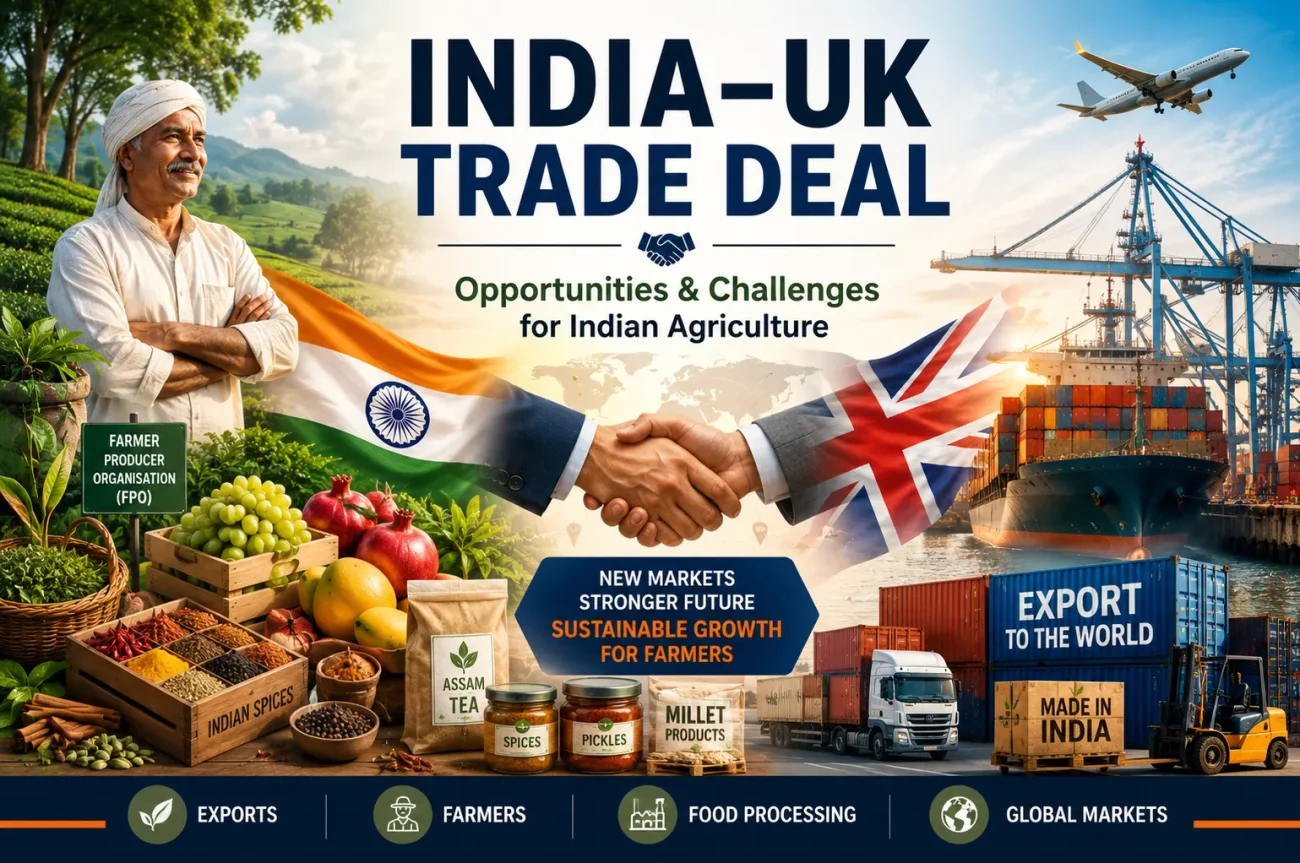
One of the agreement’s biggest achievements is the UK’s commitment to provide zero-duty access on nearly 99% of Indian exports by value. For Indian agricultural producers and food processors, this means easier access to a mature, high-value market where consumers increasingly prefer ethnic foods, premium ingredients, organic products and ready-to-eat meals.
The immediate beneficiaries are likely to be products that have already established a reputation in international markets.
Tea from Assam and West Bengal, coffee from Karnataka and Kerala, spices from southern India, marine products from the eastern and western coasts, fresh fruits from Maharashtra and Uttar Pradesh, and a growing range of processed foods are all expected to become more competitive in the UK.
The agreement is particularly encouraging for India’s food-processing industry. With tariffs coming down, exporters of fruit pulp, pickles, spice blends, frozen foods, millet-based products and ready-to-cook meals now have an opportunity to move beyond traditional ethnic stores and enter mainstream retail chains in Britain. For Farmer Producer Organisations (FPOs), agri-startups and food-processing MSMEs, the agreement could become a gateway to higher-value international markets.
Protecting the Backbone of Rural India
Perhaps the most notable aspect of the agreement is not what India opened—but what it chose to protect.
Products such as dairy, wheat, rice, sugar, poultry, eggs and several edible oils continue to enjoy safeguards. These sectors employ millions of small and marginal farmers who often have limited capacity to compete with highly mechanised farming systems in developed countries.
This protection matters because more than 86% of Indian farmers operate on holdings of less than two hectares. For these households, even a modest decline in domestic prices can significantly affect annual income.
Rather than pursuing unrestricted market liberalisation, negotiators adopted a strategy that supports exports without undermining domestic food security or rural livelihoods.
Coastal States Could See the Biggest Gains
Among the largest beneficiaries are likely to be India’s coastal states.
Andhra Pradesh, Gujarat, Kerala, Tamil Nadu and Odisha already account for a substantial share of India’s seafood exports. Improved market access could encourage additional investment in aquaculture, seafood processing, cold-chain logistics and export certification.
Similarly, horticulture-rich states such as Maharashtra, Karnataka and Uttar Pradesh stand to gain from stronger demand for premium fruits and processed food products.
The agreement also creates opportunities for Himalayan states like Uttarakhand and Himachal Pradesh, where organic foods, medicinal herbs, honey and niche horticultural products are gradually finding international buyers.
Beyond Agriculture
Although agriculture has attracted much of the attention, the agreement extends well beyond the farm sector.
Indian textile and apparel manufacturers are expected to benefit from improved market access in the UK. Leather exporters, engineering firms and pharmaceutical companies also gain from lower tariffs and easier market access.
Equally important is the services chapter, which covers 137 sub-sectors, including information technology, professional services, education and consulting. The accompanying Double Contribution Convention reduces the burden of dual social security contributions for eligible professionals temporarily working in the UK, making Indian talent more competitive overseas.
Will UK Imports Hurt Indian Farmers?
This concern deserves careful consideration.
The agreement will make certain British products—including premium chocolates, biscuits, processed foods and selected seafood—more accessible in India. However, these products primarily cater to urban, premium consumer segments rather than competing directly with staple crops produced by Indian farmers.
Moreover, India’s decision to retain protection for sensitive agricultural commodities substantially limits the risk of import surges in sectors that support rural livelihoods.
In other words, the agreement expands consumer choice without fundamentally altering the competitive landscape for most Indian farmers.
The Real Challenge Begins Now
Trade agreements create opportunities, but they do not automatically generate exports.
India’s ability to benefit from the UK market will depend on what happens at home. Farmers need better access to quality certification, testing laboratories, cold-storage infrastructure and efficient logistics. Food processors require easier access to finance, technology and international marketing networks.
Farmer Producer Organisations must be integrated into export value chains, while state governments need to invest in pack houses, traceability systems and export-oriented infrastructure.
Without these complementary reforms, tariff reductions alone will not translate into higher farm incomes.
A Template for Future Trade Agreements
The India–UK CETA demonstrates that trade liberalisation does not have to come at the expense of vulnerable communities.
Instead of opening every sector indiscriminately, the agreement combines export promotion with carefully designed safeguards. It recognises India’s strengths in high-value agriculture, food processing, manufacturing and services while preserving protection for sectors that remain central to rural livelihoods.
If implemented effectively, the agreement could increase agricultural exports, strengthen food processing, generate rural employment and improve farmers’ access to premium global markets.
Its long-term success, however, will not be measured merely by higher trade volumes. It will depend on whether the benefits reach farmers, small enterprises and rural communities across the country. That is where the real test of this agreement lies.

An article by; Prem Shankar Singh
Managing Editor, Bharat Update