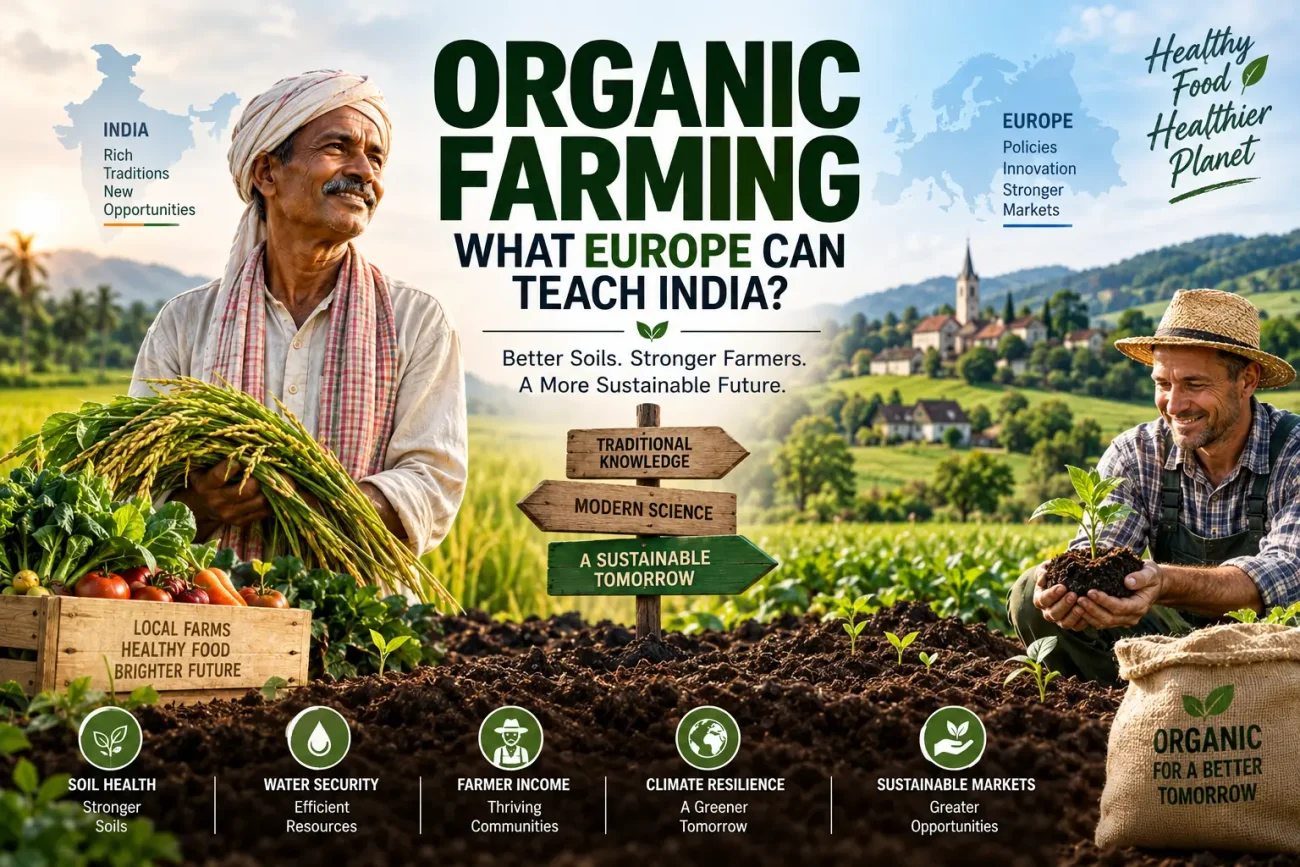
Until about 50 years ago, traditional farming methods in India were essentially a form of organic farming. The push for higher yields led to the widespread use of chemical fertilizers and pesticides, steering agriculture in a different direction. Today, farmers have to buy seeds and fertilizers every year. There is a need to harmonize modern technologies with time-tested, conventional farming practices.
India’s organic farming journey is moving from a niche movement towards an important component of sustainable agriculture. The opportunity is not simply to replace chemical farming with organic farming, but to build a more resilient agricultural system based on soil health, efficient resource use, biodiversity, climate resilience and better farmer incomes.
The scale of government support under the Paramparagat Krishi Vikas Yojana (PKVY) demonstrates that organic farming is increasingly being treated as part of India’s sustainable agriculture strategy rather than merely as a premium food segment.
As of 30 January 2025, ₹2,265.86 crore had been released under PKVY since its launch in 2015, including ₹205.46 crore under RKVY during FY 2024–25. By February 2025, approximately 15 lakh hectares had been brought under PKVY-supported organic farming through 52,289 clusters, benefiting around 25.30 lakh farmers.
India Has Already Built a Significant Organic-Farming Base
The PKVY numbers, however, represent only one part of India’s organic agriculture landscape.
According to APEDA, the total area under India’s organic certification process in FY 2023–24 was about 7.3 million hectares, consisting of approximately 4.5 million hectares of farm area and 2.8 million hectares of wild-harvest collection area.
India produced around 3.6 million tonnes of certified organic products during FY 2023–24.
More importantly, the latest NPOP data for 2024–25 show further expansion:
- About 2.25 million hectares were certified organic.
- Another 1.71 million hectares were under conversion.
- Around 2.26 million hectares were certified for wild harvest.
- Certified farm production reached approximately 4.39 million tonnes.
Organic exports also increased significantly.
In 2024–25, India exported about 368,155 tonnes of organic products worth ₹5,394 crore (US$666 million). The European Union alone accounted for about 94,230 tonnes, valued at approximately ₹1,703 crore (US$210 million).
This is important: Europe is not merely a competitor for India—it is also one of India’s major markets for organic products.
India Versus Europe: Where Does India Stand?
A comparison with Europe provides an interesting perspective.
The European Union had around 16.9 million hectares under organic farming in 2022, equivalent to 10.5% of its utilised agricultural area. Between 2012 and 2022, EU organic area increased by approximately 79%.
The EU has established an ambitious target of having at least 25% of agricultural land under organic farming by 2030 under its Farm to Fork strategy.
India’s situation is structurally different.
India has:
- A much larger farming population
- Millions of small and marginal farms
- Highly diverse agro-climatic conditions
- A much stronger dependence on agriculture for rural livelihoods
Therefore, simply adopting Europe’s 25% target would not be an appropriate policy benchmark.
The more meaningful comparison is how organic farming contributes to sustainability and farmer income.
India and European Union: A Broad Comparison
| Indicator | India | European Union |
|---|---|---|
| Organic / certification area | 7.3 million ha under certification process in FY24* | 16.9 million ha organic in 2022 |
| Farm area | 4.5 million ha farm area under certification process in FY24* | 16.9 million ha organic |
| Organic share | Much smaller share of India’s cultivated area | 10.5% of EU agricultural land in 2022 |
| Policy approach | PKVY, NPOP, PGS-India, natural/organic farming programmes | CAP + Farm to Fork + organic-action policies |
| Organic target | Scope for state-specific sustainable agriculture targets | 25% by 2030 |
| Major opportunity | Smallholder aggregation + domestic market + exports | Expansion toward 25%, environmental services |
| Major challenge | Certification, productivity transition, market access | Cost, regulation, farm profitability and consumer demand |
*India’s APEDA figure includes land under the organic certification process and therefore should not be directly equated with fully certified organic land.
This distinction is critical when comparing India with Europe.
The Real Strength of India’s Organic Model: The Small Farmer
India’s biggest advantage could actually be its biggest challenge.
European organic agriculture operates within a relatively high-income agricultural ecosystem supported by the Common Agricultural Policy (CAP), sophisticated supply chains, certification systems and strong consumer purchasing power.
India has a different structure.
The country’s organic transition can potentially be built around:
Farmer Producer Organisations → Clusters → Local Processing → Certification → Branding → E-commerce → Domestic Retail → Exports
The PKVY cluster model is therefore strategically important.
By December 2024, the Jaivik Kheti portal had registered around:
- 6.23 lakh farmers
- 19,016 local groups
- 89 input suppliers
- 8,676 buyers
This indicates that the ecosystem is beginning to move beyond production towards market connectivity.
But this is precisely where India’s next challenge begins.
Organic Farming Should Not Mean Simply “Chemical-Free Farming”
The future of Indian agriculture cannot depend on a binary choice between:
Chemical farming vs. organic farming
The more realistic future is likely to be a combination of:
- Organic farming
- Natural farming
- Integrated nutrient management
- Integrated pest management
- Precision agriculture
- Agroforestry
- Crop diversification
- Micro-irrigation
- Conservation agriculture
- Renewable energy
- Digital farm management
In other words, the objective should be sustainable intensification—producing sufficient food while reducing environmental damage and improving farm profitability.
Organic farming can be one of the most important components of this transition, but it cannot be the only component.
Soil Health May Become the Strongest Argument for Organic Agriculture
India’s agricultural future is increasingly linked to soil health.
Excessive dependence on external inputs can increase production costs and create environmental pressures.
Organic farming can contribute to sustainability through:
Organic matter → Better soil structure → Improved water retention → Greater biological activity → Improved resilience
Compost, farmyard manure, crop residues, green manure, biofertilisers and crop rotations can help rebuild soil biological health.
This becomes especially important as India faces increasing climate variability.
A healthy soil is not merely a production medium—it is also a water-storage system, carbon reservoir and biological ecosystem.
Therefore, the future policy debate should move from:
“How much land is organic?”
to:
“How much healthier, productive and climate-resilient is our agricultural land?”
A Perspective from the Organic Farming Sector
“Organic farming is India’s bridge from depleted soils and costly inputs to a healthier, more profitable agriculture. But this transition rests on one hard truth — organic is not possible on low-SOC soils, and only biochar can rebuild that carbon fast, restoring soil biology and water retention at a pace compost alone never can. With the organic market growing 20–25% annually, real value now lies in certification, processing and traceability — not cultivation alone. Organic will transform Indian agriculture the day it becomes an economy, not just a practice — farmer-owned chains from living soil to branded shelf, turning every farmer into an agripreneur.”
— Bhanu Pratap Singh
Managing Director,
BMS Organic FPC Limited
Water: The Hidden Opportunity
Organic and ecological farming can also contribute to India’s water-security agenda when combined with appropriate agronomic practices.
Crop diversification away from highly water-intensive monocultures, greater use of millets and pulses, mulching, soil organic matter management, rainwater harvesting and micro-irrigation can collectively reduce pressure on water resources.
This is particularly relevant in regions facing groundwater depletion.
Therefore, organic farming should be integrated with programmes such as:
- Per Drop More Crop
- Watershed development
- Soil-health management
- Climate-resilient agriculture
The objective should not be simply:
“Chemical-free farming.”
It should be:
“Resource-efficient farming.”
Climate Change Strengthens the Case for Sustainable Agriculture
Agriculture is simultaneously a victim of climate change and a contributor to greenhouse-gas emissions.
Indian farmers face:
- Irregular rainfall
- Heat waves
- Droughts
- Floods
- New pest pressures
- Soil degradation
- Changing crop seasons
Organic and regenerative approaches can strengthen resilience by improving soil organic matter, biodiversity and water-holding capacity.
However, policymakers should avoid making unsupported claims that every organic practice automatically reduces emissions.
The right approach is to measure outcomes:
Soil carbon + Water use + Input use + Biodiversity + Yield stability + Farmer income
This opens an important future opportunity: combining sustainable agriculture with carbon markets and ecosystem-service payments, provided measurement and verification systems become reliable.
The Biggest Weakness: Productivity and Transition Costs
Organic farming also has genuine economic challenges.
During the transition period, farmers may face:
- Lower yields in some crops
- Higher labour requirements
- Difficulties controlling weeds and pests
A recent study of organic adoption in Punjab, for example, identified labour requirements, marketing difficulties, weed management and temporary yield reductions among major challenges.
This means that simply asking farmers to “go organic” is not sufficient.
Farmers need:
3-year transition support + Technical assistance + Assured market + Certification + Processing + Price discovery
The government’s PKVY financial support is therefore important, but the next generation of policy must go beyond subsidy.
Certification Is Another Critical Bottleneck
For India’s organic sector to expand globally, trust is as important as production.
Consumers paying a premium need confidence that a product is genuinely organic.
India already has two important pathways:
NPOP
National Programme for Organic Production
PGS-India
Participatory Guarantee System
APEDA notes that India’s NPOP standards have been recognised by the European Commission and Switzerland for specified unprocessed plant products, providing an important foundation for exports.
The future challenge is to make certification:
Cheaper + Faster + Digitally Traceable + Farmer-Friendly
Blockchain is not necessarily the answer to every problem, but digital farm records, satellite monitoring, QR-based traceability and AI-assisted verification could significantly reduce transaction costs.
India’s Biggest Opportunity May Be the Domestic Market
Exports are important, but India’s 1.4-billion-plus consumer market may ultimately be the larger opportunity.
Organic food is often associated with affluent urban consumers. The challenge is to make safe and sustainably produced food accessible to a much wider population.
India could develop a three-tier market:
1. Premium Organic
Export-quality products that are certified and highly traceable.
2. Mass Sustainable Agriculture
Products produced with reduced chemical inputs and measurable environmental standards.
3. Local Ecological Agriculture
Community-based production, local markets and short supply chains.
This approach could prevent organic agriculture from becoming an exclusively premium urban phenomenon.
What Europe Can Teach India
Europe’s experience provides several lessons.
1. Set Measurable Long-Term Targets
The EU’s target of 25% organic agricultural land by 2030 provides a clear direction.
India could develop state-specific sustainable agriculture targets, rather than one national percentage.
2. Link Farmers to Consumers
Organic farming succeeds when production, certification, logistics, processing and retail operate as one ecosystem.
3. Pay for Environmental Services
Farmers should increasingly be compensated not only for food production but also for:
- Carbon sequestration
- Biodiversity conservation
- Water conservation
- Soil restoration
- Ecosystem protection
4. Build Strong Certification Systems
Trust determines whether consumers will pay a premium.
5. Use Technology
Satellite monitoring, farm-level data, AI, digital marketplaces and traceability can make sustainable agriculture commercially viable at scale.
What Europe Can Learn from India
The learning should not be one-way.
India has some unique advantages.
Traditional Indian farming systems have historically used:
- Mixed cropping
- Livestock integration
- Crop residues
- Local seeds
- Botanical pest management
- Farmyard manure
- Community-based knowledge
India also has enormous biodiversity and millions of small farms capable of producing highly differentiated products.
The future opportunity is therefore to combine India’s traditional ecological knowledge with modern science and technology.
That could produce a distinctly Indian model of sustainable agriculture.
The Next Decade: From Organic Farming to “Climate-Smart Organic Ecosystems”
The next phase of India’s organic agriculture should be based on five pillars:
1. Soil
Restore soil organic matter and biological health.
2. Water
Reduce water intensity and increase water-use efficiency.
3. Farmer
Protect farmer income during the transition period.
4. Market
Connect certified producers directly with domestic and international consumers.
5. Technology
Use digital certification, traceability, AI, remote sensing and precision agriculture.
The government’s existing PKVY ecosystem provides an important foundation.
The next step should be to transform these clusters into profitable, technology-enabled sustainable farming enterprises.
India’s Organic Opportunity: From Subsidy to Value Creation
The numbers show that India has already crossed an important threshold.
PKVY has supported nearly:
- 15 lakh hectares
- 52,289 clusters
- 25.30 lakh farmers
APEDA’s latest NPOP data show:
- 2.25 million hectares of certified organic cultivated land
- 1.71 million hectares under conversion in 2024–25
- Approximately 4.39 million tonnes of certified organic farm production
Organic exports rose to 3.68 lakh tonnes, worth ₹5,394 crore.
These numbers suggest that India’s organic sector is moving from an experimental phase towards a commercial agricultural ecosystem.
But scale alone will not guarantee success.
The central question for the next decade is:
Can India convert organic farming from a subsidy-supported production model into a profitable, market-driven and climate-resilient agricultural system?
If the answer is yes, organic farming could make a significant contribution to India’s:
- Soil security
- Water security
- Biodiversity
- Climate resilience
- Farmer income
- Sustainable food systems
Conclusion: Organic Farming Is Not the Destination—It Is Part of the Transition
Europe’s experience demonstrates that organic farming can become a significant part of mainstream agricultural policy.
India’s experience demonstrates that organic agriculture can be organised around millions of small farmers, clusters and traditional knowledge.
India should not attempt to copy Europe’s agricultural model.
Instead, it should create its own model:
Traditional knowledge + Modern science + Digital technology + Farmer organisations + Certification + Strong markets
The future of Indian agriculture is unlikely to be purely organic or purely conventional.
It will be productive, resource-efficient, climate-resilient and increasingly regenerative.
Organic farming can be one of the strongest pillars of that transformation—provided India measures success not only by hectares converted, but by:
- Farmer income
- Soil health
- Water saved
- Biodiversity protected
- Carbon reduced
- Value created per hectare
That is the real test of sustainable agriculture in India.
An article by; Alok Ranjan