
Introduction
World Environment Day serves as a reminder of humanity’s deep connection with nature and our collective responsibility to protect it. As climate change continues to affect ecosystems, economies, and communities across the globe, environmental protection has become one of the defining challenges of our time.
While technological advancement has transformed human civilization, it has also contributed significantly to environmental degradation. Today, the challenge before us is not only to understand the causes and consequences of climate change but also to take meaningful action toward a sustainable future.
Understanding the Human Impact on Climate Change
Throughout history, human innovation has driven progress. However, many of the activities that have improved living standards have also altered natural systems. Industrialization, urbanization, resource extraction, and increasing energy consumption have accelerated environmental pressures and contributed to climate change.
Today, climate change is recognized as both a natural and human-induced phenomenon. Rising temperatures, changing rainfall patterns, frequent heatwaves, and extreme weather events are visible reminders of the environmental challenges facing the world.
Although awareness about climate change is widespread, collective action often falls short of the urgency required.
Lessons from Indian Philosophy and Culture
India’s cultural heritage offers valuable lessons in environmental stewardship. Traditional Indian philosophy promotes respect for nature and recognizes the interconnectedness of all living beings.
For centuries, elements of nature such as rivers, forests, mountains, the sun, and the earth have been revered as life-sustaining forces. This worldview emphasizes harmony between humanity and the environment rather than exploitation.
As environmental challenges intensify, revisiting these principles can help guide more sustainable development practices.
Why Environmental Protection Matters
The Environment (Protection) Act, 1986 defines the environment as the interconnected relationship among air, water, land, human beings, animals, plants, microorganisms, and property.
This definition highlights an important reality: environmental protection is not limited to conserving individual resources. It is about maintaining the balance that supports life itself.
For India, where ecology and economy are deeply interconnected, environmental challenges directly affect:
- Agriculture
- Water security
- Tourism
- Public health
- Rural livelihoods
Ignoring environmental concerns today could compromise the well-being of future generations.
The Need for Innovation and Scientific Advancement
Addressing modern environmental challenges requires scientific innovation and technological advancement.
India’s leading research institutions—including IITs, IISc, IARI, and CSIR—can play a critical role in developing indigenous solutions that address environmental concerns while supporting economic growth.
Priority areas include:
- Industrial pollution control
- Sustainable waste management
- Hazardous waste treatment
- Biomedical waste disposal
- E-waste management
- Resource efficiency
- Energy security
A life-cycle approach to technology development can help ensure that environmental and social impacts are considered from production to disposal.
Balancing Green Technologies with Environmental Responsibility
The transition toward renewable energy and electric mobility is essential for reducing emissions. However, environmental considerations must extend beyond the usage phase.
For example:
- Solar power systems require responsible end-of-life management.
- Electric vehicles depend on batteries and rare-earth materials.
- Manufacturing processes can create additional environmental pressures.
Sustainable development requires evaluating the complete environmental footprint of emerging technologies and ensuring responsible resource management throughout their life cycle.
Unlocking Green Finance and Carbon Markets
Financing environmental transformation remains a significant challenge.
In addition to government support, participation in international environmental and carbon markets can unlock new funding opportunities.
Key mechanisms include:
- Voluntary Carbon Markets
- Article 6 Mechanisms under the UNFCCC
- Carbon Border Adjustment Mechanisms (CBAM)
- CORSIA and other international climate initiatives
These frameworks can help mobilize green investments while supporting climate action and sustainable development.
Nature-Based Solutions for Climate Resilience
Nature-Based Solutions are increasingly recognized as effective tools for climate adaptation and mitigation.
These approaches focus on protecting, restoring, and sustainably managing natural ecosystems while delivering environmental, social, and economic benefits.
Examples include:
- Afforestation and reforestation
- Wetland restoration
- Watershed management
- Sustainable agriculture
- Biochar production and carbon sequestration
Such solutions strengthen community resilience while supporting biodiversity conservation and climate goals.
The Role of Citizens in Environmental Protection
Environmental protection is not solely the responsibility of governments and institutions.
Every individual can contribute through simple but meaningful actions:
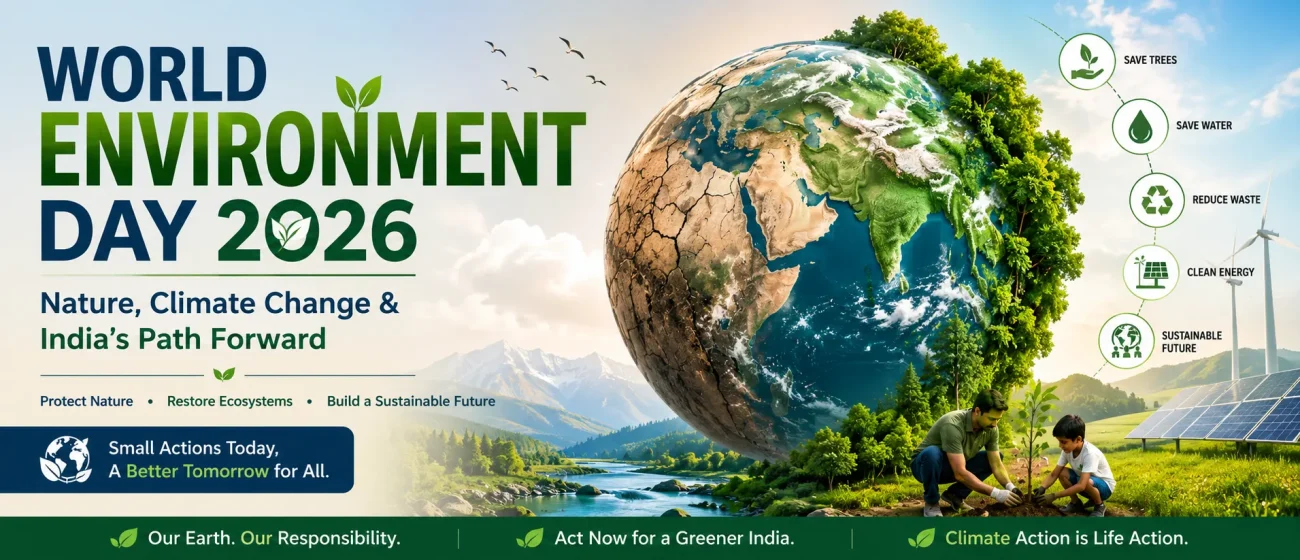
- Conserving water
- Reducing waste
- Planting trees
- Using clean energy
- Supporting sustainable products
- Practicing responsible consumption
When adopted collectively, these actions can create substantial positive impacts.
Moving Forward Together
Climate change cannot be completely reversed overnight. However, its pace and impacts can be reduced through informed decision-making, technological innovation, environmental stewardship, and collective responsibility.
World Environment Day reminds us that protecting nature is not merely an environmental obligation—it is an investment in our future.
A cleaner, greener, and healthier world requires participation from governments, businesses, communities, and individuals alike. By embracing sustainability today, we can build a more resilient future for generations to come.
Conclusion
The path forward lies in balancing economic development with environmental responsibility. Through scientific innovation, green finance, nature-based solutions, and individual action, India can continue progressing toward a sustainable and climate-resilient future.
On this World Environment Day, let us reaffirm our commitment to protecting nature, restoring ecosystems, and creating a healthier planet for all.

An article by; Sh. Sushil Kumar Singla, IFS,
Secretary, Environment, Science Technology & Climate Change, Himachal Pradesh