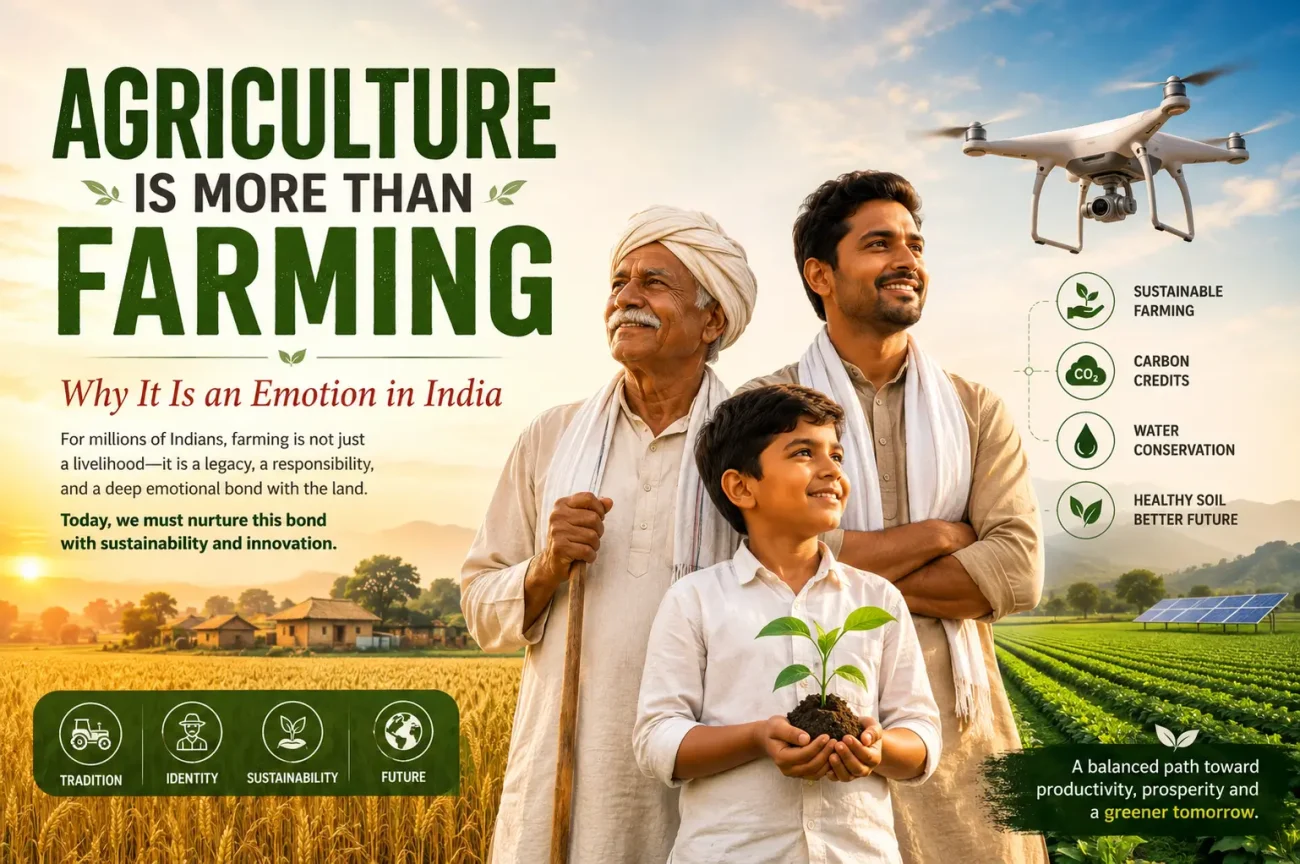
In India, farming is far more than an economic activity; it is an emotional bond with the land. For millions of Indians, ancestral farmland represents identity, security, and a sense of belonging. Even middle-class professionals living in cities often say that if they own a small piece of land in their native village, they hope to return one day. This sentiment reflects a deeper truth: agriculture in India is not merely a livelihood—it is a way of life.
Nearly 63 percent of India’s population is directly or indirectly dependent on agriculture and allied sectors. Consequently, discussions on farming extend beyond farmers alone, influencing the country’s economy, environment, and social fabric.
During the phases of industrialization and economic liberalization, large tracts of agricultural land were acquired for industrial development. While the objective was to generate employment and accelerate economic growth, the outcomes have often fallen short of expectations. Across many industrial regions, large numbers of industrial plots remain vacant, and landowners are increasingly seeking changes in land-use regulations to repurpose these properties. This raises an important policy question: Have India’s land-use strategies evolved in line with changing economic realities?
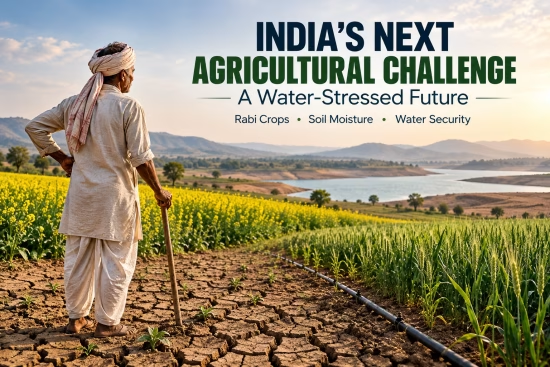
India possesses approximately 180 million hectares of cultivable land. Of this, nearly 140 million hectares are sown every year, while multiple cropping increases the country’s gross cropped area to around 220 million hectares. Despite enormous challenges, Indian farmers continue to produce record food grain harvests, demonstrating remarkable resilience, experience, and adaptability.
However, significant challenges remain. Government support schemes often reach only a section of the farming community. At the same time, agriculture is no longer evaluated solely on productivity; it is increasingly assessed through the lens of environmental sustainability and climate resilience. Soil health, changing rainfall patterns, water conservation, and greenhouse gas emissions have become central to agricultural policy and planning.
Emerging technologies have the potential to transform Indian agriculture. Drones are enabling precision spraying, crop monitoring, and field mapping, while digital soil testing and data-driven farm management are reshaping cultivation practices. Yet affordability remains a major barrier. For example, soil health testing kits typically cost between ₹12,000 and ₹75,000, making them inaccessible to many small farmers. Although the government provides 50–55 percent subsidies on tractors and agricultural drones, access remains limited, particularly for small and marginal farmers. Expanding access through greater subsidies, cooperative ownership models, or custom hiring centers could significantly accelerate the adoption of modern agricultural technologies.
Agriculture and environmental sustainability can no longer be viewed as separate agendas. They are deeply interconnected. Recognizing this, several Indian states have begun implementing carbon credit initiatives linked to sustainable farming practices. Natural farming, agroforestry, biochar, soil carbon enhancement, and regenerative agriculture are creating new opportunities for farmers to earn additional income while contributing to climate mitigation. Himachal Pradesh has emerged as one of the leading states in advancing carbon credit initiatives, offering a model that others may follow.
In the years ahead, Indian agriculture must strive for more than higher yields. The real objective should be to balance productivity, farmer prosperity, environmental conservation, and climate resilience. By combining modern technology, effective public policy, and the knowledge of millions of farmers, India has the potential to become a global leader in sustainable agriculture and climate-smart farming.
State-wise Comparison of Carbon Credit Policies in India (2026)
India’s carbon market is evolving under the national Bureau of Energy Efficiency-led Carbon Credit Trading Scheme (CCTS), while states are developing their own project pipelines, institutional frameworks, and partnerships to monetize carbon assets. The most active states currently focus on forestry, agroforestry, biochar, renewable energy, regenerative agriculture, and waste management. (PIB)
| State | Policy / Institutional Status | Major Private-Sector Partnerships | Priority Project Types | Investment Opportunity |
| Himachal Pradesh | Carbon Credit Committee; state framework under development | ProClime Services | Agroforestry, biochar, forest restoration, hydropower | ★★★★★ |
| Uttarakhand | Environment Department designated nodal agency | Projects expected through PACS, carbon developers, forest partnerships | Forest carbon, agroforestry, watershed, regenerative agriculture | ★★★★☆ |
| Madhya Pradesh | Active Green Credit and forestry initiatives | Forestry companies, carbon developers, biochar and bamboo firms | Bamboo, forestry, biochar, regenerative agriculture | ★★★★★ |
| Chhattisgarh | Strong forest-based carbon potential | Forest cooperatives, CSR partners | Forest carbon, NTFPs, bamboo, community forestry | ★★★★★ |
| Gujarat | Green Credit Programme leadership | Renewable developers, industrial decarbonisation firms | Renewable energy, mangroves, saline-land restoration | ★★★★☆ |
| Maharashtra | Carbon monetisation through urban, waste and industry | Municipal corporations, waste companies, RE developers | Waste-to-energy, landfill methane, EVs, biochar | ★★★★☆ |
1. Himachal Pradesh – India’s Emerging Carbon Market Leader
Institutional Progress
- Dedicated Carbon Credit Committee established.
- State preparing a portfolio of carbon assets across forestry, agriculture, and renewable energy.
- Targeting both voluntary and compliance carbon markets. (Press Information Bureau)
Key Private Partnerships
- ProClime Services Pvt. Ltd.
- Large agroforestry programme
- India’s first state-supported biochar initiative
- Carbon project development and credit registration
Major Projects
- Agroforestry (≈300,000 ha proposed)
- Biochar from pine needles and lantana
- Forest restoration
- Hydropower carbon credits
Investment Potential
- Carbon project development
- MRV (Monitoring, Reporting & Verification)
- Biochar plants
- Nature-based carbon credits
- Climate finance
2. Uttarakhand
Recent policy momentum has accelerated significantly.
Government Action
- Environment Department designated as the nodal agency for carbon credit initiatives.
- Forest, Agriculture and Cooperative Departments are coordinating implementation.
- Primary Agricultural Credit Societies (PACS) are expected to participate in aggregation of farmer projects. (The Times of India)
Focus Areas
- Forest carbon
- Spring and watershed restoration
- Agroforestry
- Organic farming
- Eco-restoration
Likely Private Participation
- Carbon project developers
- Forest certification agencies
- ESG investment funds
Investment Scope
- Community forestry
- Farmer aggregation
- Soil carbon
- Watershed restoration
3. Madhya Pradesh
Among India’s strongest nature-based carbon opportunity states.
Strengths
- Extensive forest area
- Bamboo resources
- Large agricultural landscape
- Active participation in the national Green Credit Programme. (ABC Live)
Emerging Opportunities
- Bamboo carbon projects
- Biochar
- Regenerative agriculture
- Wildlife corridor restoration
Private Opportunities
- Carbon registries
- Agroforestry developers
- Sustainable forestry companies
- CSR-funded restoration
4. Chhattisgarh
One of India’s richest forest-carbon states.
High-Potential Sectors
- Community forestry
- Bamboo
- Minor forest produce
- Forest restoration
- Biochar
Private Sector Opportunities
- Carbon project developers
- Forest-based enterprises
- Tribal producer organizations
- CSR climate programmes
Investment Potential
- REDD+-type forest projects
- Carbon-linked livelihoods
- Community carbon cooperatives
5. Gujarat
Gujarat combines renewable energy leadership with industrial decarbonisation.
Carbon Assets
- Solar and wind
- Mangrove restoration
- Green hydrogen
- Industrial efficiency
The state also leads current implementation under the national Green Credit Programme by eco-restoration area. (ABC Live)
Private Partners
- Renewable energy developers
- Industrial decarbonisation firms
- ESG investment platforms
Opportunities
- Carbon capture
- Renewable-energy credits
- Blue carbon
- Industrial offsets
6. Maharashtra
The country’s largest industrial economy has diverse carbon opportunities.
Major Carbon Sectors
- Waste management
- Landfill methane
- Renewable energy
- Industrial efficiency
- Urban forestry
Likely Partners
- Municipal corporations
- Waste-to-energy developers
- Climate-tech startups
- Carbon finance firms
Investment Scope
- Methane capture
- Circular economy projects
- Industrial decarbonisation
- Urban carbon credits
Comparative Assessment
| Parameter | Himachal | Uttarakhand | Madhya Pradesh | Chhattisgarh | Gujarat | Maharashtra |
| Forest Carbon | ⭐⭐⭐⭐⭐ | ⭐⭐⭐⭐⭐ | ⭐⭐⭐⭐⭐ | ⭐⭐⭐⭐⭐ | ⭐⭐⭐ | ⭐⭐⭐ |
| Agroforestry | ⭐⭐⭐⭐⭐ | ⭐⭐⭐⭐ | ⭐⭐⭐⭐⭐ | ⭐⭐⭐⭐ | ⭐⭐⭐ | ⭐⭐⭐ |
| Biochar | ⭐⭐⭐⭐⭐ | ⭐⭐⭐ | ⭐⭐⭐⭐ | ⭐⭐⭐⭐ | ⭐⭐⭐ | ⭐⭐⭐ |
| Renewable Energy Credits | ⭐⭐⭐⭐ | ⭐⭐⭐ | ⭐⭐⭐ | ⭐⭐⭐ | ⭐⭐⭐⭐⭐ | ⭐⭐⭐⭐⭐ |
| Industrial Carbon Projects | ⭐⭐ | ⭐ | ⭐⭐⭐ | ⭐⭐ | ⭐⭐⭐⭐⭐ | ⭐⭐⭐⭐⭐ |
| Farmer Carbon Credits | ⭐⭐⭐⭐⭐ | ⭐⭐⭐⭐⭐ | ⭐⭐⭐⭐ | ⭐⭐⭐⭐ | ⭐⭐⭐ | ⭐⭐⭐ |
Strategic Outlook
- Himachal Pradesh is setting the benchmark for state-led carbon monetisation, particularly through its partnership with ProClime and its biochar initiative.
- Uttarakhand is rapidly building institutional capacity and is well placed for community-based forest and agricultural carbon projects.
- Madhya Pradesh and Chhattisgarh have the largest long-term potential for forest, bamboo, and regenerative agriculture credits.
- Gujarat and Maharashtra are likely to dominate industrial, renewable energy, and urban carbon markets due to their strong industrial ecosystems.
For investors, developers, and climate-finance institutions, these six states collectively represent the strongest pipeline for carbon credit projects under both India’s compliance market and international voluntary carbon markets.

An article by; Alok Ranjan
Founder, CAARP, Communication Expert